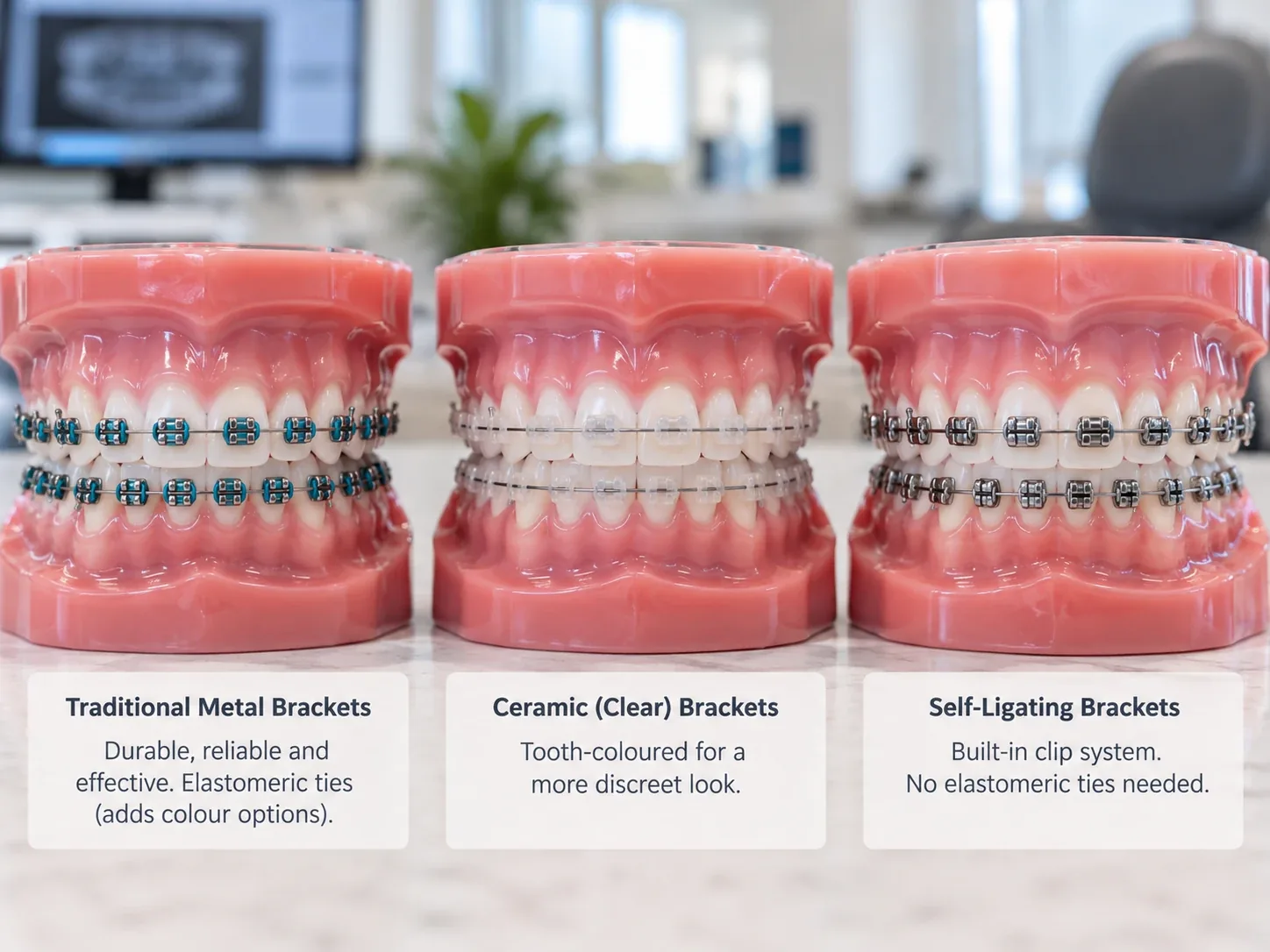
Every bracket system moves teeth the same way: a bracket bonded to each tooth, a wire running through them, and light continuous force doing the work over months. Choosing between types is mostly about trade-offs you can see and feel, not hidden clinical superiority.
How we think about the choice
We start with the bite, not the catalogue. Some cases genuinely need the strength and precision of stainless steel — heavy bite correction, extraction-space closure, an impacted canine being guided down. Some cases give us room to prioritise appearance, which is where ceramic brackets earn their premium. Self-ligating systems change the appointment experience more than the outcome. And for a nine-year-old, the deciding factor is often the colour menu, which we take entirely seriously.
What we won't do is recommend the most expensive option because it's available. Each type below is written up with its honest trade-offs, and the braces-or-Invisalign question — the bigger fork for most families — has its own page.
A closer look: how we choose brackets for a real case
A fourteen-year-old with a deep bite and rotated premolars: metal, because the case needs the strength and the rotations need grip, and because colours will get him into the chair. A twenty-nine-year-old with moderate crowding who presents to clients: ceramic on the upper front eight, metal on the lowers, smoke ties. A ten-year-old with two protruding incisors at trauma risk: partial metal braces on the front four for eight months, then a rest. A seventeen-year-old who wants aligners and whose parent is already sighing at the twenty-two-hour question: metal, kindly, with ceramic uppers if she asks. These are the patterns behind most of our recommendations, and in every case the alternative is priced beside it.
What every set of braces at our practice includes
Records and X-rays. Brackets, wires, elastics and colour ties at every visit. Every scheduled adjustment for the length of treatment. Repair visits for poking wires and loose brackets. Debonding and polishing. Your retainers, and retention checks through the first year. A defined revision policy if a result needs adjusting. It's written on the quote in that order, and it doesn't change if treatment runs long.
Frequently asked questions about braces in Coquitlam
How much do braces cost in Coquitlam?
$6,000–$8,500 comprehensive at our practice, retainers included; ceramic adds $300–$800, less if only the upper front teeth. Details.
How long do braces take?
Twelve to thirty months depending on the case; eighteen to twenty-four for most comprehensive treatment. The ranges.
Do braces hurt?
Painless to fit; a sore few days after bonding and some adjustments. Honestly.
Which braces are best for teenagers?
Usually metal, sometimes with ceramic uppers — they work regardless of willpower and the colours are the attraction.
Can adults get braces?
Yes; a quarter of our patients are adults, most in ceramic-upper configurations or aligners. Adult braces.
What can't you eat with braces?
Hard, sticky and chewy — popcorn, hard candy, caramel, ice. Everything else, cut rather than bitten. The list.
Misconceptions we correct most often
“Metal braces are ugly and old-fashioned.”
They're a fraction of the size they were, and for children the colours are the point. For adults, ceramic uppers solve the visibility question for a few hundred dollars.
“Ceramic braces are weaker and slower.”
Same mechanics, same timeline. Slightly more brittle, so the food rules matter a little more.
“Self-ligating braces are faster.”
Quicker appointments, not quicker treatment. The evidence doesn't support speed claims.
What Coquitlam families search for, answered
“Types of braces” — which do you offer?
Metal, ceramic and self-ligating fixed braces, plus the full Invisalign family. The case decides; the alternative is always priced beside the recommendation.
“Braces vs Invisalign cost”
Overlapping ranges. Limited aligner cases can be cheaper; comprehensive cases about the same. The comparison.
“Kids braces Coquitlam”
Most children under twelve get a first-phase appliance — expander, twin block, partial braces, Invisalign First — or a free recall date, not full braces. Braces for kids.
A closer look: a braces case from the inside
Month one: the light first wire unravels the worst of the crowding and the teeth feel loose in a way that alarms parents and delights orthodontists. Months two to four: friends notice; the wire steps up; colours change. Months five to nine: the working middle, where root positions and the bite level are being set and progress is invisible from the front — this is where we say "trust the plan" and mean it. Months ten to sixteen: elastics, if the bite needs them, and the stretch where the patient's hours decide the pace. The last few visits: detailing bends, fractions of a millimetre, and the conversation about retainers. Then debond. Twenty visits, most of them short, all of them included.
What the evidence says, and what we do with it
Bracket design gets a great deal of marketing. The research is calmer: self-ligating, conventional, ceramic and metal brackets produce similar results in similar times when the plan is sound; light continuous force outperforms heavy intermittent force; and the biggest predictors of a good outcome are diagnosis, patient cooperation and retention, not hardware. We choose brackets for the case and the person — strength for a heavy bite, discretion for an adult, colours for a child — and we spend our energy on the plan.
Braces and your dentist
Cleanings continue every six months through treatment and matter more with brackets. We send your dentist the plan at the start, coordinate if a cavity or a gum issue arises mid-treatment, and send the retention plan at debond so they can watch the bonded wire at every cleaning. Many of our patients arrive by referral; all of them keep their dentist.
Before you go
Read Invisalign or braces for how we'd decide your case, do braces hurt for the honest comfort picture, and cost for the fee and everything inside it. Then book the free consultation and see the plan on your own records.
Sources & references
General clinical guidance on this page is consistent with the professional and public-health bodies below. Practice-specific statements — fees, inclusions, appliances offered, protocols — come from myORTHODONTIST Coquitlam and are listed in our provider & service verification register. This page is general information and not a substitute for an examination.
- Canadian Association of Orthodontists — Professional association (Canada)
- American Association of Orthodontists — Professional association (US)
- myORTHODONTIST Coquitlam — practice protocols — Treating practice (fees, protocols, inclusions)
Written and reviewed by the certified specialists at myORTHODONTIST Coquitlam. Last reviewed: September 2026. General information, not a substitute for an examination. How our claims are verified →