- Consult
- Records
- Bond
- Adjust
- Debond
- Retain
Most children start — and often stay — right here: assessed, then monitored until the timing is right.
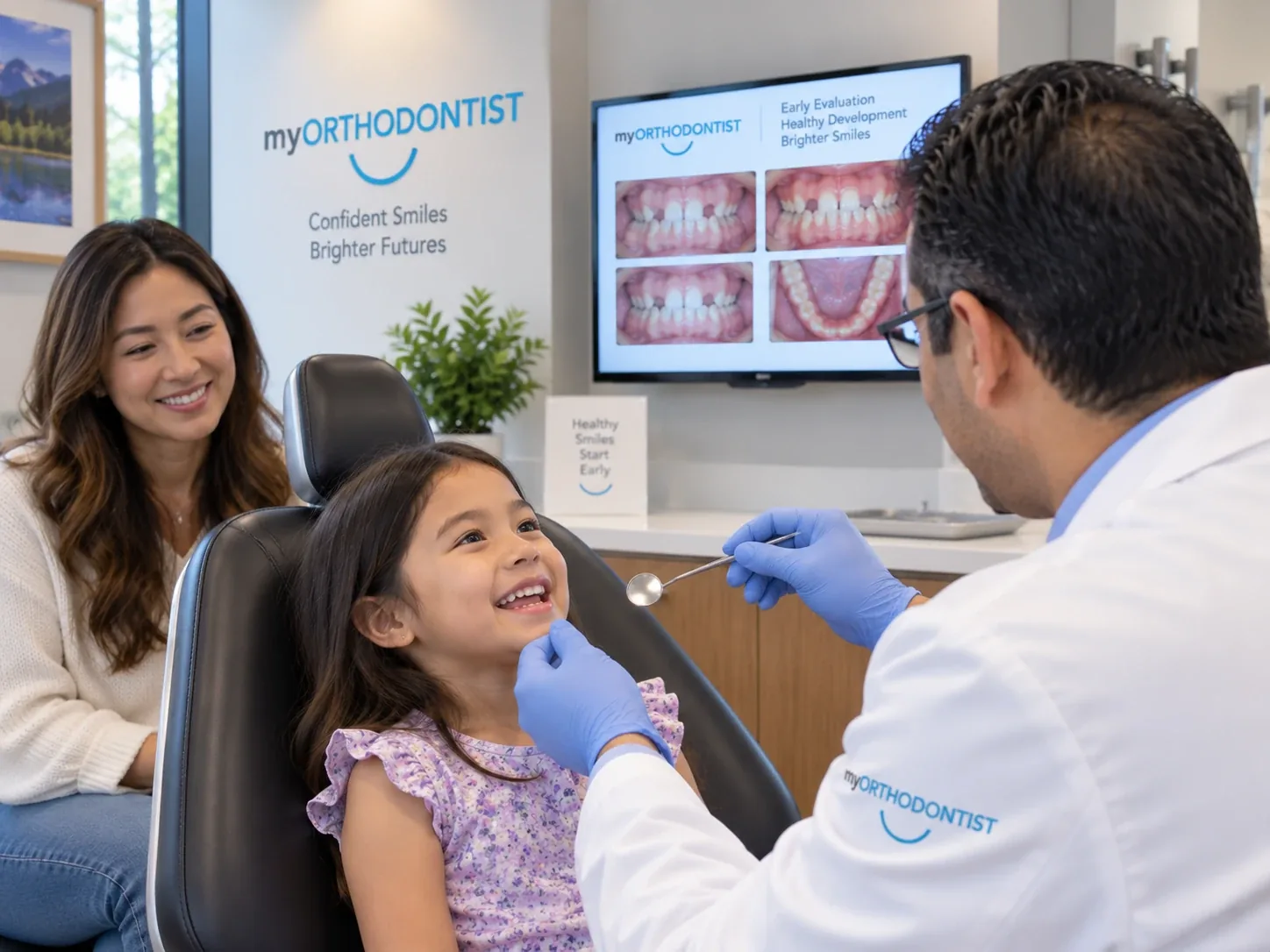
bring your child for a first orthodontic assessment around age 7. Most kids need nothing yet and enter free growth monitoring; a minority benefit from genuine early treatment for crossbites, severe crowding, airway concerns or protruding front teeth.
Why age 7?
By seven, the first adult molars and front teeth have arrived, so a specialist can read how the bite and jaws are developing while there’s still growth to work with. The assessment is surveillance, not a sales appointment — and at our clinic it’s free.
When early treatment genuinely helps
- Crossbites that shift the jaw sideways as it grows
- Severe crowding — guided expansion can create room and may avoid extractions later
- Narrow upper jaws — palatal expansion works best while growth sutures are open
- Habits like prolonged thumb-sucking reshaping the bite
- Airway red flags — mouth breathing, snoring, restless sleep; our clinic’s airway-aware screening looks at breathing and jaw development together
- Prominent front teeth at real risk of playground trauma
When waiting wins
Mild crowding, gaps and most bite quirks in a 7–10 year old are best watched. Two phases of treatment cost more than one, so Phase 1 has to earn its place with a clear clinical reason. A good orthodontist says “not yet” often — and monitoring recalls until the right start time should cost nothing.
If treatment does start
Children’s options include partial braces, expanders and Invisalign First — and yes, braces come with colour choices, which for many kids is genuinely the best part. Read the 10 signs your child might need braces for what to watch for at home.
How it works at our practice
Children at our clinic are assessed around seven, mostly monitored for free, and treated early only for a specific indication we can show you on the records — a crossbite steering the jaw, a narrow palate, a lower jaw sitting back, a habit reshaping the bite, airway flags. When we recommend a first phase, we name what it prevents and quote both phases honestly.
Frequently asked questions
What does a children's orthodontic assessment involve?
A look, a panoramic X-ray, an airway screen and a plain verdict — about forty minutes, free.
What is Phase 1 treatment?
An appliance during growth — expander, twin block, partial braces or Invisalign First — that changes how the jaws develop.
Does my child need braces or just monitoring?
Most need monitoring. The assessment tells, on evidence.
Will early treatment avoid braces later?
Usually a shorter, simpler second phase — not none.
Related reading
- Why age 7 — the timing
- Two-phase treatment — the logic
- Expanders — the commonest first appliance
The bottom line
Assess at seven, monitor most, treat early for the specific patterns that reward it. A first phase that names what it prevents is worth it; one that can't is a second invoice.
A closer look: what "monitor" means at our practice
It means a free visit every twelve months, a look at the eruption sequence and the arch width, and an honest statement each time: still developing well, or a pattern has emerged that's worth acting on. Most children we assess at seven are monitored for three or four years and then treated once in their early teens — a shorter treatment than they'd have had otherwise, because we caught the timing. Monitoring isn't doing nothing; it's watching closely so that when something needs doing, it's done at the right moment.
The first-phase appliances, and what each is for
An expander for a narrow upper jaw — crowding, crossbite, sometimes breathing. A twin block for a lower jaw sitting back, often with expansion built in. Partial braces for a crossbite of one tooth or protruding incisors at trauma risk. Invisalign First for arch development and dental corrections in a child who'll wear the trays — one of our preferred tools for those cases. A habit appliance for a thumb that won't stop. One job each, during a window, named before it's placed.
Frequently asked questions about children's orthodontics
Is early treatment necessary?
For specific skeletal patterns, genuinely. For most children, no — monitoring is the plan, and it's free.
What happens at a 7-year-old's assessment?
A look, a panoramic X-ray, an airway screen, a plain verdict. Forty minutes, free, usually reassuring.
Will Phase 1 mean no braces later?
Usually a shorter, simpler second phase — not none. We set that expectation honestly.
How much does early treatment cost?
$2,000–$4,500 at our practice with retention included, quoted alongside the likely second phase. Details.
My child snores — is that orthodontic?
Sometimes partly. See your doctor first; then let us look at the palate and jaw position.
Misconceptions we correct most often
“Every seven-year-old needs an orthodontist.”
Every seven-year-old benefits from a look. Most need nothing but a recall date.
“Expanders are painful.”
Brief pressure after each turn, quick adaptation, and one of the highest-value tools in children's orthodontics.
“Wait until all the adult teeth are in.”
Right for mild crowding; wrong for a crossbite steering the jaw or an emerging underbite, whose windows close by twelve.
What Coquitlam families search for, answered
“Signs my child needs braces”
Crowding, early or late tooth loss, protruding teeth, crossbites, underbites, mouth breathing, thumb sucking past five. The ten signs.
“Kids orthodontist Coquitlam”
Free assessments around age seven, early and Saturday slots, siblings back to back. Book.
“Two-phase orthodontic treatment”
When it earns its cost, and when one phase wins. The logic.
A closer look: a first phase, month by month
Month zero: records, the reason shown on the X-ray, the plan and both phases' likely fees in writing. Month one: the appliance fitted — an expander, a twin block, partial braces or Invisalign First — and a week of thick speech and soft food. Months two to nine: visits every six to eight weeks, a screw turned or a tray changed at home, a profile or an arch visibly changing. Months ten to twelve: the appliance out or passive, a retainer in, a rest. Then two to four years of free monitoring while the adult teeth arrive. Then a second phase in the teens — shorter, simpler, and usually without extractions for the room made early.
What we believe, and what we don't
We believe guiding jaw growth while it's possible is the most valuable orthodontics many children will ever receive — that a narrow arch widened at nine or a small lower jaw guided forward at ten means fewer extractions, a simpler teenage phase and no surgical conversation at twenty. We don't believe every seven-year-old needs an appliance, and we won't put one in a child whose jaws are developing well. The skill is telling the two apart on the records, and naming what a first phase prevents before recommending it.
Before you go
Why seven, then the ten signs, then the money. Then book the free assessment — the most common outcome is reassurance, and it's still worth an hour.
Sources & references
General clinical guidance on this page is consistent with the professional and public-health bodies below. Practice-specific statements — fees, inclusions, appliances offered, protocols — come from myORTHODONTIST Coquitlam and are listed in our provider & service verification register. This page is general information and not a substitute for an examination.
- Canadian Association of Orthodontists — Professional association (Canada)
- American Association of Orthodontists — Professional association (US)
- myORTHODONTIST Coquitlam — practice protocols — Treating practice (fees, protocols, inclusions)
Written and reviewed by the certified specialists at myORTHODONTIST Coquitlam. Last reviewed: September 2026. General information, not a substitute for an examination. How our claims are verified →